Tuesday, June 26, 2012

Cold, Wind, and Rain


That pretty much sums up last week in Melbourne. I know I just talked about how wonderful the autumn weather was, but winter seemed to roar in to Victoria after I wrote that post! It does rain quite often here, but typically there will be an occasional or random shower and then it will be sunny again. Last week, however, we had two straight days of nearly constant rain, leaving the ground saturated with water. 
Flooded paths near our house
And the wind…I don’t think you can really understand how cold the wind is here until you actually feel it on your skin. It is essentially coming straight from Antarctica, and it is shockingly cold. I should probably clarify “cold”, because quite a few people reading this post are from Minnesota, where winter can be brutally chilly. Wind chills last week were often below zero Celsius, for example, the air temperature was about 5 degrees Celsius (40 degrees Fahrenheit), but with the wind it felt like -2 degrees, or 28 degrees Fahrenheit. I also think that I notice the cold air more because I walk to work and to the gym most days. It’s one thing to run in the cold, because you warm up after the first five or ten minutes. But my walk is about 20 minutes each way, often into a fierce wind, and by the end I’m usually telling myself that I should have worn a hat and gloves to walk to work! I guess I am simply in denial that I need to wear my winter gear in Oz. :)
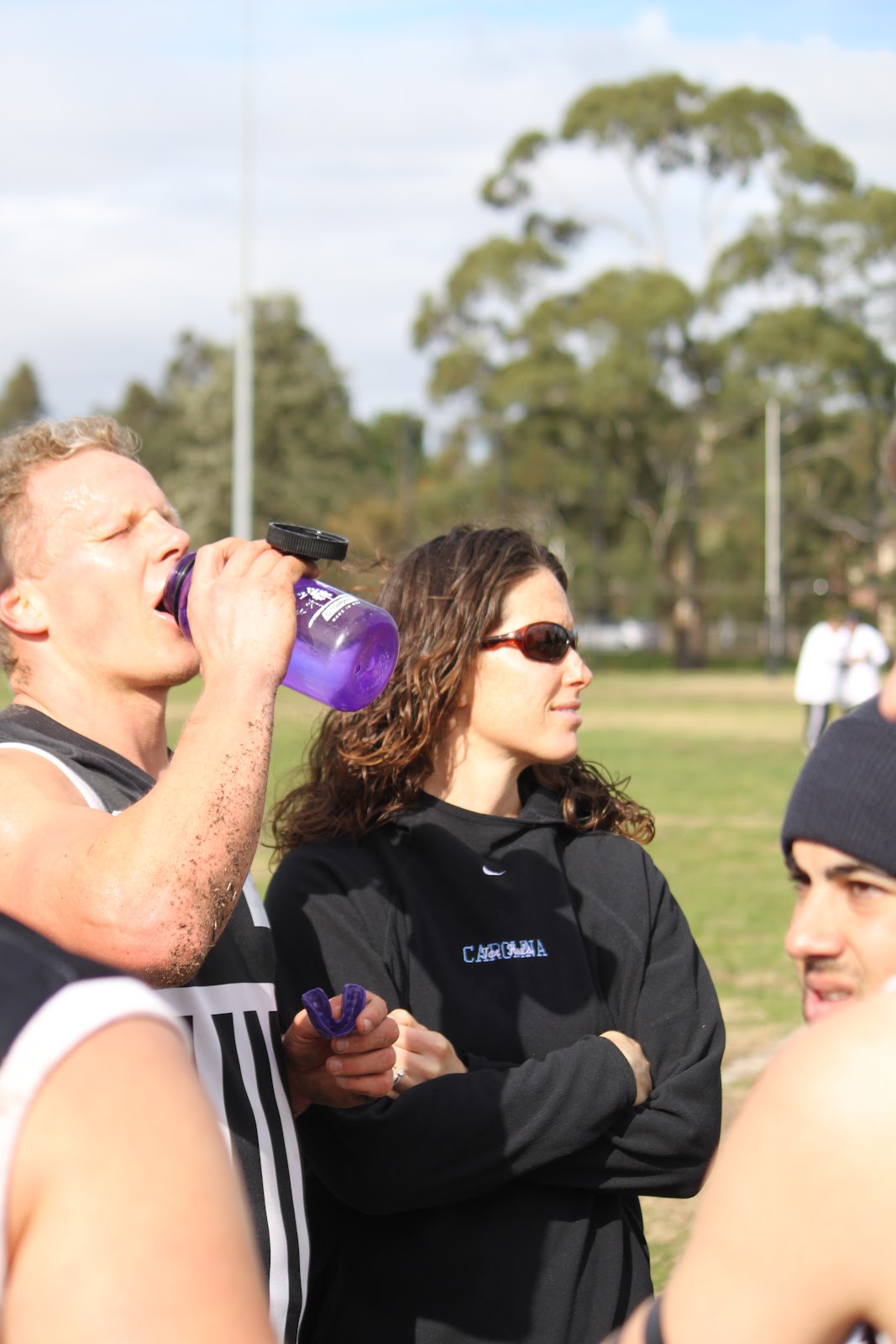
On Saturday, I spent all day working at the footy field, and as you can see, the sun was shining brightly, but the field was a disaster from the week's weather. I have seen some wet fields, especially when working in Eastern Baltimore County, but this field was so wet that massive amounts of water sprayed up with every step taken by the players. This was early in the morning, and three games were played on this field over the course of the day. Let's just say my white "work" pants (yes, it was someone's bright idea that sports trainers should be mandated to wear white pants) will never look the same.
As far as the rain goes, I’ve been told that winter is often the rainiest season of them all. Because we arrived in August, we only caught the tail end of winter, which involved a little bit of rain and a few cool days but nothing like we had last week. Of course there are beautiful days as well, and the forecast for the next few days appears to contain sunny skies and pleasant temperatures. However, as I’ve mentioned a few times, you cannot trust a weather forecast in Melbourne!

Sunday, June 17, 2012

Autumn in Australia

The title of this post should really be "Autumn in Melbourne", because I know that there are some places in Oz that do not really experience a true Autumn due to climate and location. At lot of people from back home have asked if we see the leaves change color. In short, "yes", but not all trees change color and the colors are not nearly as dramatic as what you might see in Western Maryland or Northern Minnesota. I'm not a botanist, so I don't claim to be familiar with the names of all of the trees in the Melbourne area, but I believe that many of the trees are from the Eucalyptus family, commonly referred to as "gum trees". Correct me if I'm wrong, fellow Aussies, but I do not think that these trees lose their leaves or greens in the winter months. Many produce flowers at some point that I'm assuming die off in Autumn weather. Melbourne is also home to many palm trees, as our winters seem to be mild enough for the palms to handle.

Erik and I are fortunate enough to live on a tree-lined street of trees that do change color, so it has been enjoyable to watch the change of seasons take place right in front of our house. Technically winter began on June 1st, as the Australians don't seem to believe in following the solstice like we do in the States. The first two and a half weeks of winter have been really nice for the most part, with temperatures in the upper 50's to low 60's during the day and low to mid 40's at night. The following pictures were taken about two weeks ago. Now there are far less leaves hanging around on the branches some trees have lost all of their leaves!
Our street in the middle of the day during the week.
Packed with cars at night even though each house has a two car garage!


Not quite enough leaves for a good leaf pile!

Early moon rise.
Fortunately in just a few days we will start seeing more hours of daylight!

Sunday, June 10, 2012

Things Overheard in an Australian High School

For the past few months, I have been spending about two days per week doing CRT work at a local high school. As if it's already not difficult enough to be a substitute teacher for adolescents ages 12 to 18, teaching in another country adds a new dimension to the job. I've been fortunate to become a "preferred" CRT teacher for this local school, so that means I'm one of the first people that gets called if they need substitutes. What that also means is I have subjected myself to filling in for all subject areas, so I've taught Wood Tech, Media, Maths (way too many times considering I'm terrible at math), and Year 8 Italian, to name a few. I thought you might be interested in learning a few things about how school is different in Oz compared to the United States, so I've created my own top ten list of things that would help you survive in the classroom if you decided to "have a go" at teaching these lovely Aussie children.

10. High school here is, in fact, called College. For example, instead of attending Westminster High School, I would have attended Westminster College. If students graduate high school (they can legally drop out after Year 10, I believe), they go on to "Uni", or University, though the longer version of the word is rarely used here. Students do understand if I use the term "high school" and I think that has a lot to do with the fact that they are familiar with the American educational system due to watching television shows and movies.

9. To get into Uni, students do not take the SAT or ACT. They have exams in each subject, collectively called the VCE, throughout the course of Years 11 and 12 (some accelerated students can start taking VCE exams in earlier grades). Those scores are compared with other students around the state and they basically get ranked by their test scores, similar to how the SAT scores work with percentiles, I think. All students must take VCE exams if they want to graduate from high school, even if they do not plan on attending college. I still have much to learn about VCE testing, but from what I gather, what you do in Years 7-10 doesn't matter that much because it's all about how well you do on your VCE examinations. I was told by a Year 12 class last week that sometimes in lower grades students do not even receive letter grades, just marks such as satisfactory or unsatisfactory, but I have not yet confirmed that finding.

8. If a student asks if an assignment needs to be done in grey-lead, they are asking if it needs to be completed in pencil. I found this term commonly used in the university class that I taught this semester as well!

7. There are several breaks during the course of the day and they are wonderful! At the school where I teach most often, there are two 47 minute classes in the morning followed by a 20-ish minute break for snack/recess, two more classes followed by a 47 minute lunch, and then two final classes before the end of the day. Sometimes those "two" classes are actually a double of the same subject. There is also a 20 minute period of "sustained silent reading" or "SSR" after the recess period in the morning, and the students seem to adhere quite well to the rules of being silent and having something to read (teachers must read as well...no grading or internet searching allowed during SSR).

6. Hamish is a very popular name and it's pronounced HAYmish, not HAMish.

5. Aussie children, and many adults, cannot distinguish between the Canadian and American accent. And apparently it is rare to be an American CRT, as many of their foreign teachers have been Canuks. Admittedly, I can not differentiate between the Australian accent and the New Zealand accent, but I'm getting better, I think!

4. When a student asks their classmate for a "rubber", they are talking about an eraser. Pencils (or grey-leads!) don't seem to be manufactured with erasers on top here, which I find very strange.

3. Study up on the NBA, because that is pretty much the only U.S. sport these Aussie children care about. I've tried to explain many times that college basketball is far superior to the NBA, but usually that just causes blank stares.

2. A marker is called a "texta". A white board marker can, according to the students, be called a marker, but a marker that you might color with or a Sharpie, for example, those are textas.

1. Be prepared to answer the question "is college really like it is in the movies, like American Pie"?! I find that is a difficult question to answer. College/Uni lifestyle seems much different here than at home. Many students live with their parents and commute, because some universities have very little on-campus housing. I sometimes think that my Australian students seem to overlook the fact that occasionally college students in America do go to class and they must actually pass all of their classes in order to remain enrolled in college. They tend to focus on the frat parties, sporting events, and Spring Break trips that they see on television instead.

This is by no means an inclusive list, but it will help get you started. While you are working hard to remember these items, you should know that they do not use the word "schedule" here, but "timetable" instead. Be sure to get up-to-date on your technology too, because attendance is taken using your own personal iPad (quite a nice perk if you ask me)! Also, be sure not to use the terms freshman, sophomore, junior, or senior, because the students will surely look at you like you have a second head.
The "bright" side of getting up early to go to work. :)

Sunday, June 3, 2012

Laundry

Sometimes it is the little changes to life in Oz that tend to be the most noticeable. Laundry is something I never really thought twice about in the States. I did a few loads over the weekend and I didn't mind washing, drying, or folding laundry. Now, however, that has changed!

The first major difference between doing laundry here compared to the U.S. is that the size of washing machines are much smaller. At home I would generally be able to get away with putting a LOT of clothes into one load of laundry, but that does not happen here. Technically the weight capacity of our washing machine is 6 kilograms, which works out to about 13 pounds. Seems like a lot, but the size of the machine is so darn small that it always seems like I cannot get all of our dirty clothes inside the machine. In addition to the size of the machine, it just does not seem to get clothes all that clean, though perhaps that is because I'm still overloading the machine with too many dirty clothes?!

The second and most challenging difference is that we are dryer-less. I realize that many people live life without a dryer (pretty sure my in-laws did for many years), but it seems much more common in Oz to not have a clothes dryer than it is in the States. Nearly every house/apartment here has a built-in clothes drying rack, something that would be rare in the US of A. The issue of not having a dryer comes into play for several reasons. Melbourne has ridiculously unpredictable weather. It will sometimes be a gorgeous sunny morning and then by afternoon it is cold and rainy. Twice now, I've done laundry when the forecast was for nice weather, left clothes out on our clothesline, only to return to find them soaked. A few weeks ago when the days started getting a bit chillier and the daylight hours shorter, I noticed that even on beautiful days, the laundry was just not drying. Enter: indoor clothes drying rack. I started using the indoor rack, which was nice because I did not have to check the weather forecast before putting in a load of laundry. However, the clothes still seemed to take days to dry. The rack is also a bit small, so I literally have clothes hanging in various places all over the house.

A few weekends ago at footy, one of the "moms" on the team told me her strategy for drying clothes. She told me that she puts the clothes on drying racks in one of the small bedrooms, closes the door, and turns up the heat in the house. Many homes here seem to have gas duct heating, and this method of heating warms up the house much quicker than the electric heating we used in the States. According to a few of my Melbournian friends, it is actually not uncommon to have a dedicated "clothes drying room" in the house! Anyway, I did this in one of our bathrooms, and while it helped to dry the clothes a bit faster, it also made the bathroom smell like mildew. Not exactly success. Erik suggested we open the door for a bit, which helped with the smell and the clothes still seemed to benefit from being placed under the heating duct.
Yes, the drying rack is set up in the bathtub!
It does help that many of our clothes are dri-fit material, so they dry rather quickly. On the other hand, I do have to think twice if I'm going to wash a pair of jeans or a sweatshirt, because those items might take 5 days to dry completely! Another thing I miss about having a clothes dryer is the absence of wrinkle release. I am not good with a clothes iron, so previously if my clothes were a bit wrinkly I would just toss them in the dryer for a bit to get the wrinkles out. I believe I've used an iron more times in the last few months than I have in my entire life! We have considered buying a clothes dryer, but now that we have sorted out a few strategies to assist in drying the clothes, I believe that life will go on without one. :) In fact, I think that after this experience of not owning a clothes dryer, we might look at having one in the future as a luxury!

Sunday, May 27, 2012

Saturday Routine

Local footy season is now into Round 7, so for the last 7 Saturdays, with the exception of the one that we were in Brisbane, Erik and I have been spending most of the day watching and/or playing footy. As I mentioned at the beginning of the season, Erik plays for the "2's", or reserves, which is the first "adult" game played on Saturday. There is an under 18's game that is played before the 2's game, which I will have the pleasure of working in a few weeks when the "head" sports trainer is away on vacation. His game starts at noon and he has to be there by about 10:45am. I need to be there about 11:45am, but since we only have one car, if the game is away, I go a bit early with Erik and bring things to do for an hour before I start working. The home field is about a 20 minute bike ride for E, so for home matches he rides his bike and lets me have the car.

I work as the sports trainer for the first half of Erik's game while the head sports trainer takes a lunch break, since she has been there working since about 8:30am. Around half time, I go into the locker room to help her get the 1's ready. This involves mostly taping and massage. The Aussies love their massage. In the States we would typically use a heat pack, stretching, and perhaps a warm up on the bike to loosen up muscles, but here it's all about massage. It is something that has been hard to get used to, especially because some of the players think massage is a "cure" for injuries, while what they really need to be doing is stretching and rehab on a regular basis. As I've gradually gained more respect with the club, I have been making the guys aware of these things and a few are starting to listen, I think.

Around 2pm, Erik's game finishes and the 1's warm up for a few minutes before their game begins at 2:15. The game lasts about 2.5 hours (4 - 25 minute quarters with breaks at quarter time and half time), and during the game I'm often running on the field for injuries or taking care of players on the sidelines. One thing that has been extremely difficult for me to get used to is that sports trainers are able to run on the field while the game is being played. The second a player goes down, someone is yelling for the "trainers" to get on the field. Yes, sometimes those athletes are legitimately hurt and need to be carried off of the field, but often they just need a minute to "walk it off". I've spent a lot of my career "learning" to determine whether or not I need to go on the field for athletes when they go down, and now I am told to run out immediately, regardless of how bad the injury is. I do think it's a bit overkill and I tend to gingerly run out to an athlete who I think is going to be okay, while most of the sports trainers in our league are sprinting out to those athletes right away.

After the game I help players with ice and give advice to injured players about what they should do during the week. Every week we always have several injuries, and every week I tend to be shocked at just how many people get hurt. I can count SO many games that I've worked as an athletic trainer in the States when no one got hurt. In 7 rounds of footy, there have been multiple injuries in every game! Two weeks ago we had 2 shoulder subluxations and one dislocation, a high ankle sprain, a hamstring strain, and a hip pointer, along with a few other "minor" injuries. This week it was an eyelid laceration, an AC joint sprain, and a severe quad contusion. The number of injuries actually plays a huge role in footy because you only start the game with 4 substitutes, so if 2 are out due to injury, you are left with only 2 subs for the rest of the game. We have had several games this season where 4 players were injured, leaving us with no substitutes. Needless to say, that causes the guys to get "puffed"!

Erik usually stays to watch the 1's game, and after the game, players from both teams are encouraged to stick around the clubhouse to drink beer, eat food, and watch MORE footy on the telly (Aussie-speak for television). The coach gives out awards to the best player from each team (the best player from the opposing team gets a 6 pack of beer!), and sometimes there is free food for players and staff. Even after away games, guys will go back to the home clubhouse to hang out and have a beer. It's a good time to get to know the players, and I certainly am enjoying the friendships that Erik and I are forming due to being part of the footy club. One of those players was nice enough to offer to take pictures of Erik when he noticed that I had brought our camera, knowing that it was hard for me to try to "work" and photograph the hubby at the same time.
The black electrical tape on E's arm is in memory of 2 people close to the team who passed away this week. This seems to be done in all levels of footy. Before the game, each player does this, and sadly we seem to be doing it nearly every week this season!
Benefit of your wife being a sports trainer - she brings you her water bottle to drink out of at quarter time!
Erik getting a "mark", or a catch. "Marks" are a statistic kept throughout the game.
Using those tailback skills to dodge the opposing team.
Kicking the footy, a skill that has been hard for Erik to learn (the footy is shaped differently than an American football and is meant to be kicked end over end - not in a spiral), but one that he has really improved upon, according to his coaches and teammates. 
Erik in a "contest" for the ball. I know E hates wearing the mouth-guard and a lot of guys do not wear them, but I strongly encourage him to so and fortunately he obliges.

Monday, May 21, 2012

Casual Relief Teaching

At the moment, I'm still working several different jobs and I'm enjoying the variety that they have to offer. Presently, I am available for casual relief teaching (Aussie-speak for substitute teaching) 3 days a week. I have made myself available for primary (basically kindergarten through 6th grade) and secondary (7th through 12 grade) schools, and I'm more likely to work as a CRT (the common abbreviation for casual relief teachers) in Physical Education, because that is the subject area for my teaching degree.

One thing about CRT work that is hard to get used to is that it's incredibly unpredictable. One week I might get called all 3 days and the next week just 1 day. The way substitutes are organized here is very different from when I have worked as a substitute in the States. I started subbing over my first winter break of college, so December of 1997, for Carroll County Public Schools. Over the course of college I spent many days as a sub in CCPS and also in Wicomico County Public Schools. Their systems for finding subs were telephone-based, so a teacher would call out and then the system would start calling potential relief teachers until someone accepted the job. These calls might occur the night before or early in the morning (probably by 7am at the latest) on the day of absence. I would imagine that in 2012 they have probably gone to an internet-based system but I cannot confirm that for sure. Here in Oz, there is NO telephone system and NO internet system...it's just done by people in an office who get calls from the daily managers at schools around 7am and then start calling substitutes for the day. So usually I do not get calls about working until 7:30am and sometimes as late as 7:45, when the school needs you to be there at 8:15 or 8:30. The point is, that I have to get up and "get ready" to go to work, when I might not even get called to go to work!! I did explain these telephone systems to 2 different CRT agencies (the school systems don't find substitutes...they hire agencies to do so), and they seemed amazed that such a system could exist (which I find amusing because the telephone system was operating in the 1990's!). The agencies did mention that they like their system because it helps them build relationships with the schools and the CRT teachers by communicating via the phone, but usually when I get a call they talk to me for 2 minutes and then call the next CRT teacher.

Physical education teachers might be the only ones that understand the next quirky thing about Aussie schools, but perhaps elementary school teachers reading this might decide to come to teach here because of it! When teaching PE in elementary school in the States, the grade level teachers walk their class to PE and then pick them up at the end of class. Here, the PE teacher does both! In addition, the PE teacher might be required to take morning attendance in the classroom or to take the students back to the classroom at the end of the day to help them pack up their things. I had to do that with kindergartners last week and it was nearly impossible to get twenty-some 5 year old kids packed up with ALL of their belongings in the 15 minutes of time that I had allotted for "end of the day" activities!

Last week was my first experience with kindergartners (technically they are called "grade prep" here..."kinder" is like pre-K and is not associated with schools), and I had 3 separate classes for an hour each in PE. I think an hour is a really long time to have that age group in PE, so I tried to mix it up and played many different games with them. It was a fun change from my typical subbing of high school students, because it's always nice when you tell kids to go run and touch a wall and they get excited like it's the best thing they've done all day. :) After running around for a while, these 5 year olds are yelling "I'm puffed" and "I'm gassed", as apparently those are Aussie words used to describe "out of breath" or "exhausted", ha! I also had a student take a tissue out of his pocket to tell me that he "bless you'ed" and his mum (they don't use "mom" here) had given him a tissue for when he bless you'ed, so I promptly told him to put it in the "rubbish bin" (saying "trash can" might have confused the kid!).

In the high school setting the students are generally very curious about where I'm from and why I'm here. Most don't really make an effort to learn my name and they just call me "Miss", but I have noticed that some of the students call their regular teachers "Miss" as well, so I think that might be a common occurrence here. At the high school level I'm often getting stuck with year 9 maths (not sure why they add an "s" to math, but they do!), which is often quite challenging. I have been lucky to get a few groups of 12th graders and I have really enjoyed working with the older students.

Two other random observations from both schools are that: Lachlan is a ridiculously common Aussie name, and I kind of like it. Some of the boys abbreviate it to "Lachy" or "Lachie" though and I'm not a fan of those names. Also, teacher's mailboxes are called "pigeon holes". I have absolutely no idea why we just don't call them mailboxes. The only thing I can think of is that mail here is called "post", so maybe postboxes would be weird?! I just know that the first time another teacher told me to leave notes for the teacher I was covering in their "pigeon hole", I was a bit confused. :)
Sunrise from our bedroom "balcony" one morning last week

Monday, May 14, 2012

Cinco de Mayo

Back in the States, it had become a tradition to celebrate Cinco de Mayo with Erik's University of Maryland classmates. We wanted to continue the tradition here, even though we are a long way from Mexico and it is not a commonly celebrated occasion in Oz. The date snuck up on us and we didn't realize that it was so close until we were getting ready to leave for Brisbane. At that point we tried to get something organized and fortunately many people were still available on the date of the party, which actually fell on the 5th of May! :)

When deciding on the menu, I knew that beergaritas were a must-have for this event, but what I didn't think about was the fact that I cannot just walk into a store and buy limeade concentrate, which is a necessary ingredient for the beergaritas! Fortunately, I found a few recipes online and I was able to make homemade limeade concentrate, which the guests suspected led to the deliciousness of the beergaritas (though I've had them with the canned stuff and I still think those are delicious, too)! We were able to use proper American enchilada sauce, thanks to a shipment made by my good friend Mo late last year. We were saving the sauce for a special occasion and this proved to be the perfect time to use it. Next year, we'll tackle homemade enchilada sauce.

It was a true multicultural event at our house, including guests from our current home country along with friends from New Zealand, Canada, Spain, and Italy! A good time was had by all and I'm confident that our group will grow even larger (and perhaps even more diverse?!) by the time Cinco de Mayo rolls around in 2013.
Enchiladas, anyone?!